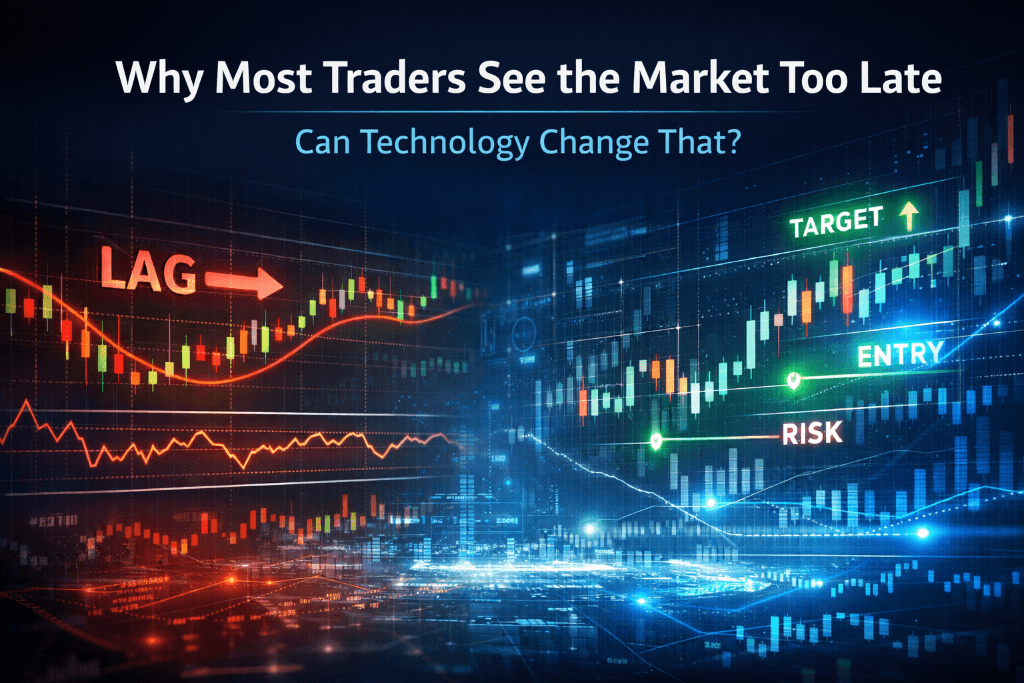
Why Most Traders See the Market Too Late — And Can Technology Change That?
Most traders identify opportunities only after the move has already started. Can technology change that?
One of the biggest problems in trading is not necessarily knowledge.
It's reaction speed.
Most traders identify opportunities only after the move has already started — and often enter exactly when the market is already near exhaustion.
This is why traders often feel the market 'moves against them': they enter when the move is already in an advanced stage, while the big players are starting to reduce their exposure.
The reason is simple: most tools traders use are based on Lagging Indicators.
The Chart Shows What Already Happened
When a trader sees on the chart:
• A moving average breakout • A trend change • A momentum indicator • A MACD crossover • An RSI buy signal
In most cases, a significant portion of the move has already occurred.
These indicators are not necessarily 'wrong' — they are simply designed to confirm an existing move, not to identify it at its beginning.
It's like a driver receiving road information only after they've already passed the turn.
In fast markets like forex, crypto, or tech stocks, this delay can be significant.
The Real Problem: Noise
The modern market generates an enormous amount of information every moment.
The average trader is exposed to many data points simultaneously:
• Fast price movements • Changing volatility • Trading volumes • Economic news • Macro data • Social media sentiment • Institutional activity
For a beginner trader — and sometimes even an experienced one — it's very difficult to process all this information in real time.
The result is a well-known phenomenon in trading: Signal vs Noise
Lots of noise. Little real signal.
When there is too much information, decision-making becomes harder — and sometimes less accurate.
Why Traders Enter at Exactly the Wrong Time
Many traders enter the market exactly when:
• The move is already clearly visible • The chart looks 'safe' • The market is already after a breakout • Or when social media starts talking about the move
In many cases, this is exactly the stage when the big players have already been in the trade for a long time.
This means the small investor often buys when liquidity is being created for large institutions to exit.
This is not necessarily manipulation — it's simply how a financial market works.
This Is Where Algorithmic Tools Come In
In recent years, more and more traders are starting to use technological tools aimed at helping them understand the market more clearly.
These tools are based on broader data analysis than a single indicator.
Their goal is to:
• Identify areas with higher probability • Filter noise from the chart • Present significant price levels • Help the trader understand the context of the move
Important to understand — such tools do not predict the market.
They simply allow the trader to analyze it more efficiently.
Why Advanced Indicators Are Becoming Popular
One of the directions developing in the trading world is combining multiple layers of analysis into one system.
Such systems sometimes combine:
• Classic technical analysis • Volatility metrics • Algorithmic filters • Market structure analysis • And built-in risk management
The goal is to create a system capable of presenting clearer signals within market chaos.
For example, platforms like SP Trade AI try to approach this problem from a technological angle.
Instead of overwhelming the trader with dozens of different indicators, the system analyzes the data and presents information in a simpler and clearer way, such as:
• Potential entry zones • Possible profit targets • Risk levels • And broader market context
For many traders, this simplicity can be a significant advantage.
The Future of Trading: Human-Technology Collaboration
Modern trading is no longer based solely on intuition or experience.
Hedge funds, banks and institutional bodies have been using advanced models for market analysis for years.
These models analyze enormous amounts of data and identify patterns that the human eye struggles to see.
Today, some of these technologies are starting to become available to private traders.
This means a private trader can work with a level of information that was previously only available to large institutions.
But here too, it's important to remember one thing:
Technology can help — but it does not replace discipline and risk management.
The Bottom Line
The market hasn't gotten simpler.
It has become:
• Faster • More complex • And more competitive
For many traders, the question is no longer just: 'Where is the market going?'
But also: 'What tools am I using to understand it better?'
Ultimately, the edge in trading does not come only from predicting the market.
It comes from the ability to analyze information more intelligently, act at the right time, and manage risk consistently.