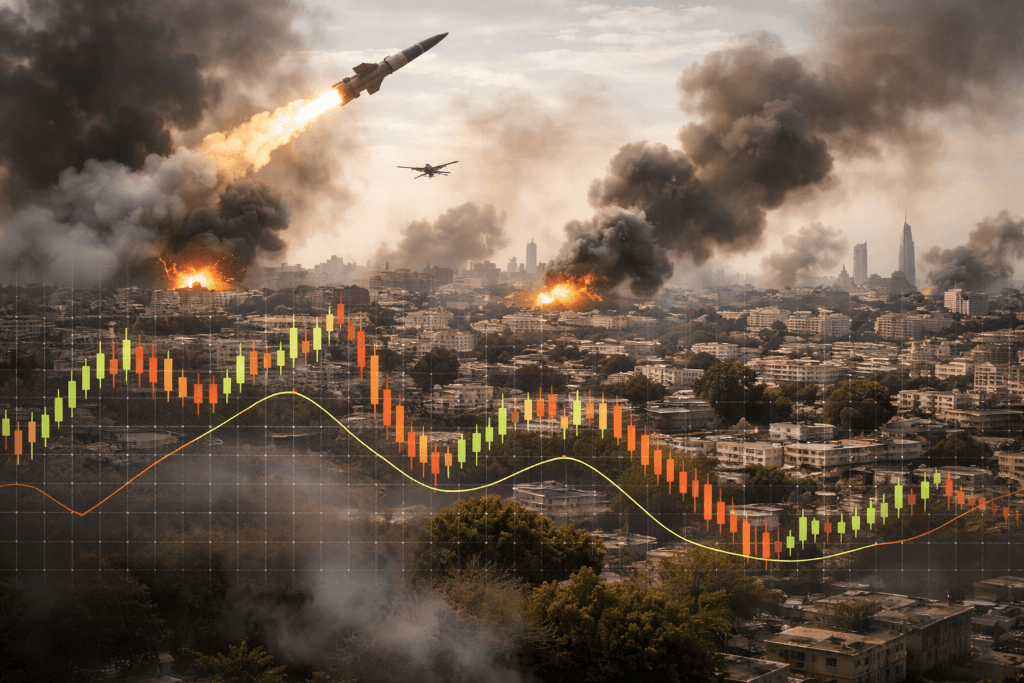
When the Middle East Escalates: How Global Markets React and What Investors Must Understand
A military escalation in the Middle East is not just a geopolitical event — it is a global financial event. How do gold, oil, the dollar, and equities react, and what should investors do?
A military escalation in the Middle East is not just a geopolitical event — it is a global financial event. Each time tensions in the region intensify or turn into direct conflict, financial markets respond almost immediately. Volatility rises, commodity prices shift rapidly, and investors seek safety.
Behind the dramatic headlines, however, there is a recurring market pattern that tends to repeat itself during crises.
1. Gold – The Classic Safe Haven
When geopolitical risk increases, gold typically strengthens. The reason is simple: institutional investors and hedge funds move capital into assets that are not tied to a single country's economy, corporate earnings, or immediate inflation shocks.
In most major geopolitical crises over the past decades, we've seen a rapid allocation shift into gold during the initial escalation phase. However, it is important to note: gold does not always continue rising indefinitely. Often, the move is sharp but short-term.
2. Oil and Energy – High Regional Sensitivity
The Middle East plays a central role in global energy supply. Any threat to production, shipping routes, or involvement of major oil-producing nations can trigger sharp moves in oil prices.
Rising oil prices directly affect:
- Inflation expectations
- Equity markets
- Future interest rate decisions
As a result, the impact of regional conflict often extends far beyond the region itself.
3. The U.S. Dollar – Safe Haven Flows
During global uncertainty, the U.S. dollar is typically perceived as a relative safe haven. Institutional capital often flows toward the dollar in times of geopolitical stress.
Emerging market currencies, on the other hand, tend to experience higher volatility and capital outflows.
4. Equity Markets – Not Every Drop Is a Collapse
Equity markets often react negatively in the early stages of escalation. Fear-driven selling can increase volatility, sometimes pushing the VIX index sharply higher.
Historically, however, geopolitical events that do not evolve into prolonged global conflicts tend to impact markets primarily in the short term. After the initial uncertainty phase, markets frequently reprice risk and stabilize.
The key takeaway: panic selling is usually emotional, not strategic.
5. Volatility – Threat or Opportunity?
For passive investors, volatility creates discomfort. For active traders with strict risk management, volatility creates opportunity.
When daily ranges expand:
- Profit targets increase
- Stop-loss levels widen
- Strategies must be adjusted accordingly
However, high volatility without disciplined risk management can quickly turn into significant losses.
6. Three Common Mistakes Investors Make During Crises
- Making decisions driven by fear
- Increasing leverage to recover losses
- Trading without a structured plan
Crises themselves rarely destroy portfolios — emotional reactions do.
The Bottom Line
Escalation in the Middle East impacts global financial markets — but not always in the way headlines suggest.
Gold, oil, the U.S. dollar, and equity markets react quickly. Yet in the longer term, markets refocus on fundamentals: growth, interest rates, and macroeconomic data.
For investors and traders, the critical question is not whether a crisis exists — but whether there is a strategy designed for uncertainty.
Every crisis carries risk. Every crisis also carries opportunity.