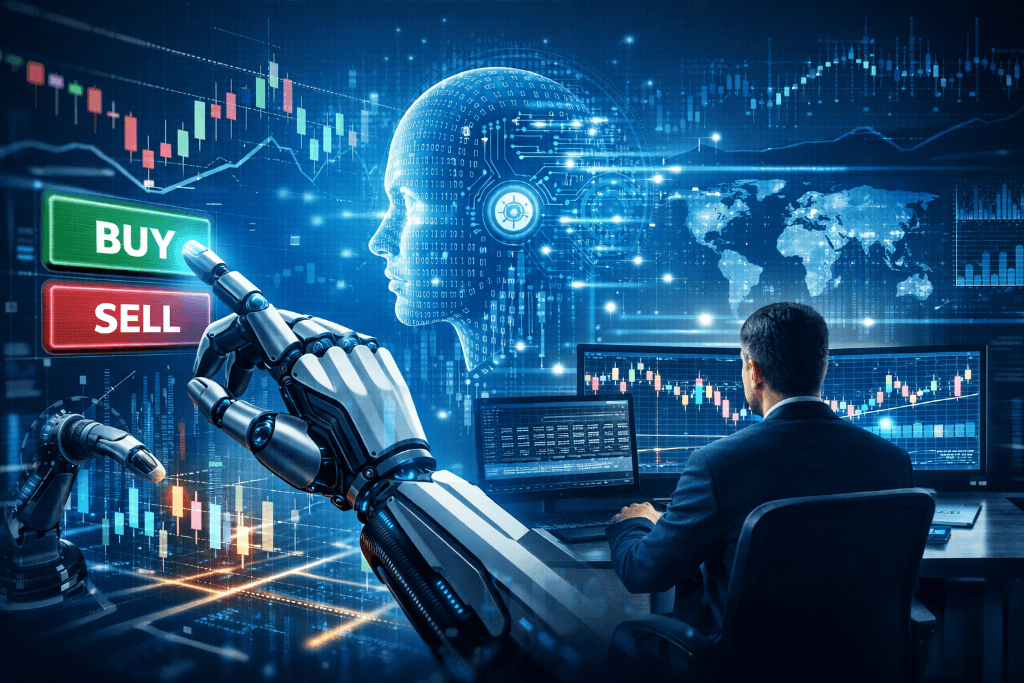
Is the Future of Trading Fully Automated?
Will trading eventually become fully automated? Explore how algorithms, AI, and automation are reshaping financial markets — and what role human traders will play in the future.
Is the Future of Trading Fully Automated?
For decades, trading in financial markets has been associated with individuals analyzing charts, interpreting indicators, and manually executing trades.
But that reality is changing rapidly.
In recent years, algorithmic trading systems, automation tools, and artificial intelligence have begun transforming the way markets are analyzed and traded. What was once reserved for large institutions is gradually becoming accessible to individual traders.
The question now being asked across the industry is simple:
Will trading eventually become fully automated?
The Rise of Algorithmic Trading
Algorithmic trading is not new. Large hedge funds and institutional trading desks have been using automated strategies for years.
These systems are designed to:
- analyze massive amounts of market data
- identify patterns
- execute trades within milliseconds
According to several market studies, more than 70% of equity trading volume in the United States is now executed through algorithms.
This trend has fundamentally changed the structure of modern financial markets.
Why Automation Is Growing So Fast
There are several reasons why automated trading systems are becoming increasingly popular.
First, machines are faster.
Markets move at speeds that are often impossible for humans to react to consistently. Algorithms can process information and execute trades in fractions of a second.
Second, automation removes emotional bias.
Many traders struggle with fear, greed, hesitation, and overtrading. Automated systems follow predefined rules without emotional interference.
Third, automation allows for scalability.
A trader can monitor one or two charts manually. An algorithm can monitor dozens of markets simultaneously.
The Role of Artificial Intelligence
Artificial intelligence is the next major evolution in automated trading.
AI models can analyze large datasets, detect complex relationships between market variables, and continuously adapt strategies based on new information.
In practice, this means trading systems can evolve and improve over time instead of relying solely on fixed rules.
While AI does not guarantee profits, it introduces a new level of analytical power that was previously unavailable to most traders.
Will Human Traders Disappear?
Despite rapid technological progress, it is unlikely that human traders will disappear entirely.
Instead, the role of traders is shifting.
Rather than manually executing trades, many traders are becoming system designers and strategy managers.
They focus on:
- building trading models
- managing risk
- supervising automated systems
In other words, the human role moves from execution to strategy.
The Hybrid Future
The most likely future of trading is not fully manual and not fully automated.
It is a hybrid model.
Human traders will increasingly rely on automated tools to analyze markets, identify opportunities, and execute trades — while still maintaining control over strategy and risk management.
Those who adapt to this new environment will likely gain a significant advantage.
Because in modern markets, success is no longer just about reading charts.
It is about combining human judgment with technological power.