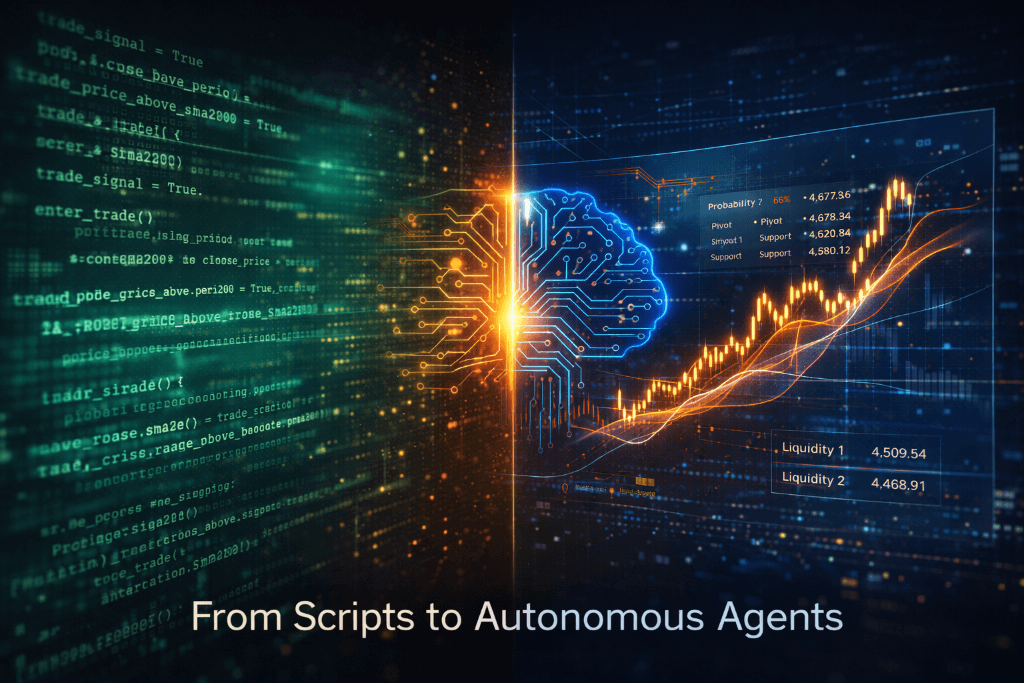
From Simple Scripts to Autonomous Agents: The Evolution of AI in Automated Trading
A comprehensive look at how AI-powered trading has evolved from simple rule-based scripts to sophisticated autonomous agents that can adapt to real-time market conditions.
The financial markets have always been a race not just for capital, but for information. In the early days, the "edge" was a faster runner or a direct telephone line. Today, the edge is code.
As we look at the landscape of automated trading, it's clear we are in the middle of a massive paradigm shift. What started as simple automation has evolved into sophisticated Artificial Intelligence capable of "thinking" about the market in ways humans cannot.
Here is a look at the evolution of AI in trading bots and where we are heading next.
Phase 1: The Rule-Based Era (The "If-Then" Bots)
The ancestors of modern AI bots weren't really "intelligent" in the way we use the word today. They were strict rule-followers.
How they worked: Programmers would hard-code specific logic: "If the 50-day Moving Average crosses above the 200-day Moving Average, BUY."
The Limitation: These bots were excellent at executing orders instantly (removing emotional hesitation), but they were rigid. If the market conditions changed—for example, if volatility spiked due to a geopolitical event—the bot would blindly follow its rules, often leading to losses. They lacked adaptability.
Phase 2: Machine Learning and Quantitative Analysis
As computing power grew, so did the complexity of the bots. We moved from static rules to Machine Learning (ML) models.
The Shift: Instead of telling the bot exactly what to do, developers began feeding the bots massive amounts of historical data. The bots would "learn" probability. They analyzed decades of price action to identify patterns that were statistically likely to repeat.
The Capability: These systems could handle more complex variables, adjusting their parameters based on historical volatility. This was the era where "Backtesting" became the gold standard.
Phase 3: The Era of Deep Learning and NLP (Current State)
This is where platforms like SP TRADE AI are changing the game. We are no longer just looking at price charts; modern AI is looking at the world.
Sentiment Analysis: Using Natural Language Processing (NLP), today's advanced bots can "read" news headlines, parse central bank meeting minutes, and even gauge fear or greed on social media in milliseconds.
Real-Time Adaptation: Unlike the old "If-Then" bots, modern AI signals are dynamic. They don't just execute; they manage risk. If a "Black Swan" event occurs, deep learning models can recognize the anomaly and adjust position sizing or exit trades immediately, protecting capital in ways static scripts never could.
The Future: The Autonomous Co-Pilot
We are rapidly approaching a future where trading bots act less like tools and more like partners. The goal of sophisticated platforms today is not just to automate the clicking of buttons, but to automate the strategy itself.
Tools like our Nostro Bot and JSP10 Indicator represent this leap combining technical precision with the adaptability required for modern markets.
The evolution of AI has democratized what used to be the exclusive weapon of hedge funds. You no longer need a PhD in mathematics to harness the power of algorithmic trading; you just need the right platform.