58% Since Early 2025: How a Probability-Based Trading System Creates Consistent Edge
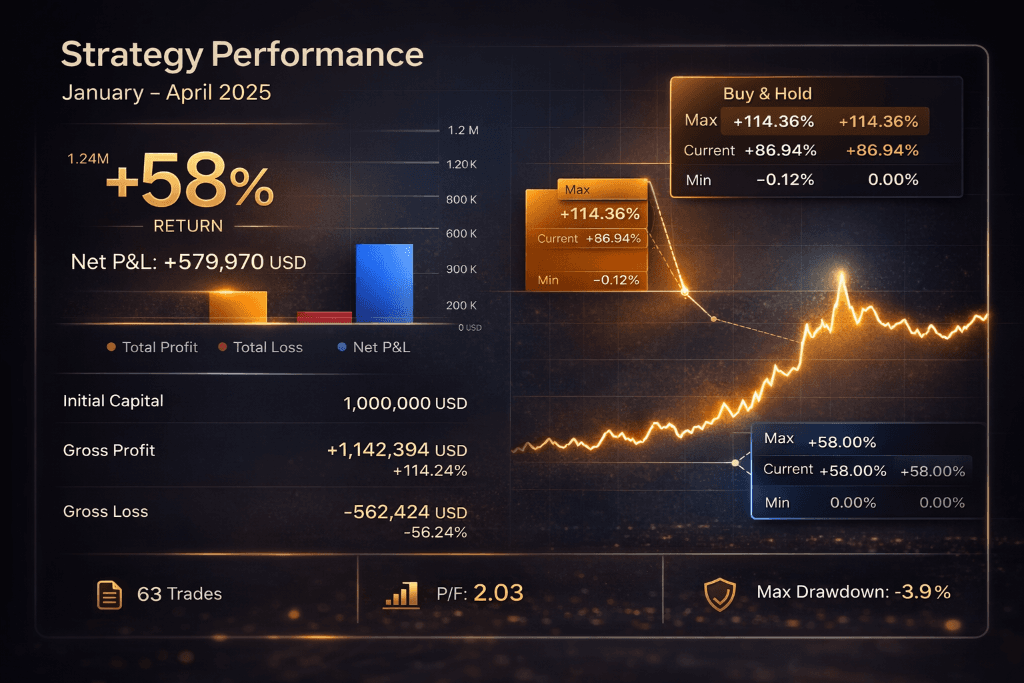
While most traders struggled with 2025's volatility, one algorithmic system delivered 58% returns. Not magic - mathematics.
While Most Traders Struggled with Volatility, One Algorithmic System Maintained Clear Direction
2025 wasn't an easy year for trading.
Sharp volatility in indices, sudden moves in gold, rapid shifts in market sentiment, and an unstable crypto market. Most retail traders experienced erosion mainly due to emotional decisions and inconsistent risk management.
But there's a difference between emotional trading and system-based trading.
Since early 2025, an AI-based algorithmic indicator with advanced risk management has shown a 58% return while maintaining a calculated risk structure.
Not magic. Not luck. Mathematics.
What's Behind the 58%?
A professional trading system doesn't rely on predictions. It relies on probability.
The algorithm is based on:
- Average risk-reward ratio of 1:2
- Smart liquidity zone identification
- Volatility Filtering
- Moving stop to Break Even at critical probability point
- Fixed percentage portfolio exposure management
- Daily Drawdown control
In simple terms: Control losses before talking about profits.
Why 58% Matters More Than It Seems
Most traders look at profit percentage. Professionals look at risk structure quality.
A 58% return is especially significant when achieved:
- Without extreme leverage
- Without overexposure
- Without "position doubling"
- While maintaining consistency
This isn't a one-time "explosion." It's gradual building with probabilistic edge.
AI in Financial Markets - Not a Trend, But a Necessity
According to Bloomberg data and institutional firms, over 60% of US trading is executed via algorithms.
The implication? If you're a manual trader, you're competing against:
- Faster systems
- Real-time probability calculations
- Market noise filtering
- Sentiment analysis
An AI-based indicator doesn't guarantee success in every trade - but it enables cold, data-driven decisions without emotion.
The Difference Between a Signal and a System
There are countless indicators in the market. Most provide an "entry point."
A real system provides:
- Entry
- Defined profit target
- Precise stop loss
- Lot calculation
- Position management structure
When everything is pre-structured - discipline is no longer user-dependent.
Why It Works Even in Volatile Periods
2025 proved one thing clearly: Volatility isn't an enemy if you know how to manage it.
Combining:
- Volatility filter
- Liquidity zone identification
- Positive risk-reward ratio
- Drawdown control
Allows the system to work even when the market is unstable. And that's exactly where most traders break.
The Real Question
The question isn't whether a system can profit. The question is do you have a clear probabilistic edge against the market.
The financial market is a mathematical game. And those operating without a system play against algorithms with an edge.
In Summary
58% since early 2025 isn't the result of correct guessing. It's the result of:
- Methodology
- Probability calculation
- Strict risk management
- Algorithmic discipline
And in today's market - a small mathematical edge, over time, is all the difference.